Tickets
Guided visits and skip-the-queue entry
Most of Krakow’s busier sites sell timed entry online, and several are far better with a guide who can explain what you are looking at.
Some links on this page are partner links. If you book through one, Krakow.com earns a commission at no extra cost to you. It is what keeps the guide free. Who pays us.
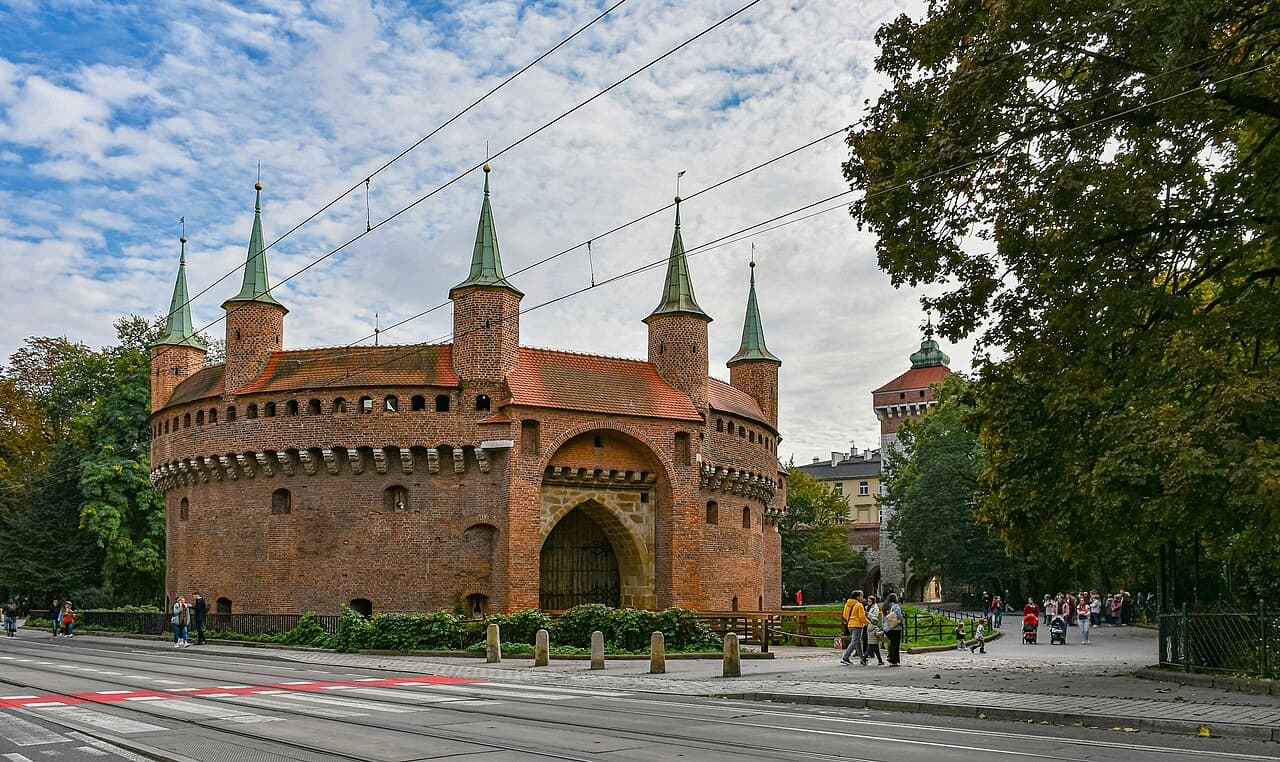
Standing at the edge of Krakow's Old Town, this circular fortress feels less like a museum piece and more like a time portal. The Barbican (Barbakan) is one of the finest surviving examples of medieval military architecture in all of Europe - and at 22 PLN (reduced 16 PLN), it's one of the city's most underrated experiences.
History & Background
Built in 1498 during a period of intense political tension, the Barbican was constructed as the outermost defensive ring protecting Krakow from potential Ottoman and Tatar invasions. It formed part of a sophisticated fortification system, originally connected to the Florian Gate (Brama Floriańska) by a long neck passage, though much of that corridor was demolished in the 19th century. The structure's Gothic design - a thick circular tower crowned with 7 turrets and pierced by 130 loopholes - wasn't just decorative. Every detail served a deadly purpose, allowing defenders to rain arrows and fire down on attackers from multiple angles simultaneously. That it survived centuries of war, occupation, and urban development is remarkable in itself.
What to Expect
Approaching along ul. Basztowa, the Barbican rises suddenly above the surrounding greenery of the Planty gardens, and the sheer mass of its stone walls makes an immediate impression. Inside, the space is surprisingly atmospheric - thick walls, worn stone floors, and narrow passages that genuinely evoke the medieval period. Summer exhibitions bring rotating displays of weapons, armor, and historical artifacts, while the open courtyard occasionally transforms into an arena for medieval battle reenactments that draw enthusiastic crowds. Budget around 30 to 45 minutes for a thorough visit - longer if you catch a reenactment. The views from the upper level looking back toward the Florian Gate are genuinely photogenic.
Insider Tip
Most visitors photograph the Barbican from the front and move on. Instead, loop around the full exterior perimeter through the Planty gardens - the back side reveals the building's true scale and offers a quieter, more dramatic view that almost nobody stops for. Also worth knowing: the Barbican shares a combined ticket with several other city fortifications including the Florian Gate and City Walls, which represents significantly better value if you plan to explore the full defensive circuit. Ask about the combined option at the ticket window before paying for entry separately.
Before you go
Quick answers
- What are the opening hours of Barbican (Barbakan)?
- Tue-Sun 10:00-16:00.
- How much does it cost to visit Barbican (Barbakan)?
- 22 PLN, reduced 16 PLN.
Close by
All restaurants →Eating nearby
Close by
All hotels →